Ainslie School
ACT 2025
In 2025, the Telling Your Stories (TYS) project reached a significant milestone with its first international implementation at Ainslie School in Canberra, Australian Capital Territory. What began as a potential commemorative project evolved into a deeply transformative, place-based literacy initiative: one that strengthened identity, deepened cultural understanding, and redefined how story can function as a pedagogical tool.
This report outlines the journey, processes, and emerging impact of the Ainslie School pilot. It highlights how storytelling, when grounded in place, voice, and community, becomes far more than a literacy exercise—it becomes a mechanism for belonging, inquiry, and connection to Country.


"Ainslie School has laid a powerful foundation. One that positions literacy not just as a tool for learning, but as a pathway to belonging, identity, and connection."
An excerpt from the Ainslie School Impact Report
The Process

PHASE 1
Establishing Foundations
The project began with a deliberate and relational approach. An initial meeting with leadership established clarity around purpose, scope, and readiness. Key stakeholders were identified, including teachers, students, First Nations educators, historians, and community members. This phase emphasised: ⭐️ Authenticity over speed ⭐️ Collaboration over delivery ⭐️ Listening as a foundational practice The in-person engagement signalled the importance of relational trust. The TYS team immersed themselves in the local context, exploring Canberra’s layered histories, from First Nations custodianship to colonial development and contemporary civic identity. This immersion was critical. It grounded the work not in abstraction, but in lived experience, ensuring the story would emerge from place rather than be imposed upon it.

PHASE 2
Co-Design & Story Gathering
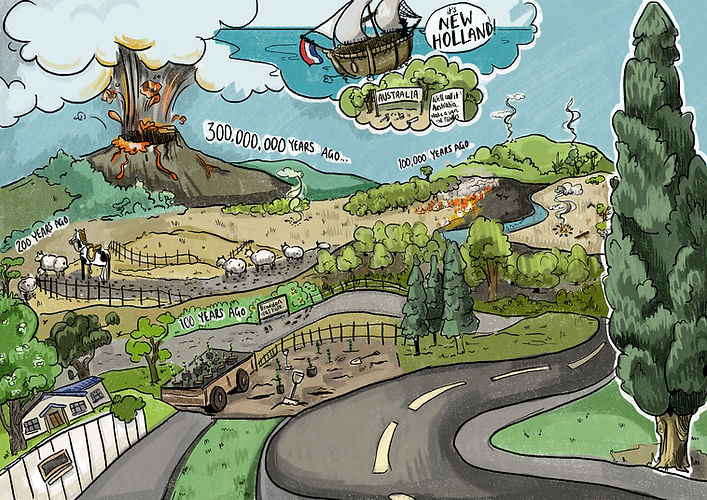
Central to the TYS approach is co-construction. The story is not written for a school, t is created with the community. A facilitated workshop brought together diverse stakeholders to explore a central provocation: “What is it that is important for the children of this school to know about THIS place?” This question unlocked a rich process of inquiry. Participants shared: ⭐️ Personal stories and memories ⭐️ Historical artefacts and records ⭐️ Cultural knowledge and perspectives ⭐️ Observations of the natural environment Emerging themes included: ⭐️ Deep time and First Nations histories ⭐️ The ecological identity of the area- ⭐️ The evolution of Canberra as a capital city ⭐️ The lived experiences of the Ainslie community A key design decision was to position trees as narrators—a powerful metaphor that reflected both the physical landscape and the concept of Country as teacher. This choice enabled the story to: ⭐️ Traverse time (past, present, future) ⭐️ Hold multiple perspectives ⭐️ Ground abstract concepts in tangible, local elements

PHASE 3
Drafting and Refinement
The drafting process was rigorous, iterative, and deeply collaborative. A 2000-word narrative was developed across eight interconnected sections, designed to be both engaging and pedagogically rich. Key considerations included: ⭐️ Accuracy of historical and cultural representation ⭐️ Developmental appropriateness for students ⭐️ Alignment with the Australian Curriculum ⭐️ Integration of First Nations perspectives with guidance from cultural advisors This phase surfaced critical tensions: ⭐️ Whose stories are prioritised? ⭐️ How do we represent contested histories? ⭐️ What constitutes “truth” in storytelling? Rather than avoiding these tensions, the process embraced them. Facilitated dialogue allowed participants to navigate complexity with honesty and care, ensuring the final narrative was balanced, respectful, and purposeful.
PHASE 4
Classroom Launch
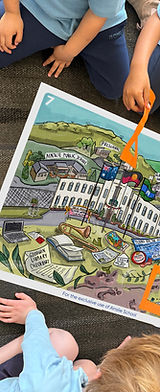
Once the story, imagery, and supporting assets were confirmed, the project moved into a final phase focused on transforming the narrative into classroom-ready resources and embedding it within school practice. This phase ensured the story was not simply completed, but actively launched, understood, and used by teachers and students. Resources were refined for practical classroom application, with attention to accessibility, curriculum alignment, and opportunities for inquiry, discussion, writing, and place-based learning. The launch with the school created a shared point of entry for staff and students, helping the narrative become part of everyday teaching and learning rather than a standalone project. Key outcomes included: ⭐️ Classroom readiness – resources were adapted into usable formats for teachers, including visual, print, video, and planning materials ⭐️ Staff confidence and ownership – teachers were supported to understand how the story could connect with existing curriculum programmes ⭐️ Student engagement and identity – students encountered the story as a living part of their school environment, supporting belonging, curiosity, and connection to place ⭐️ Sustained curriculum integration – the story became a flexible resource that could be revisited across year levels, learning areas, and classroom contexts The project shifted from development to implementation, ensuring the story could have ongoing impact as a shared cultural, historical, and educational resource within the school community.
THE IMPACT
The Ainslie School pilot demonstrates that storytelling, when approached with integrity and intention, can transform educational practice.
This project is not simply about producing a story. It is about:
-
Reconnecting learning to place
-
Honouring diverse histories and perspectives
-
Empowering students to see themselves as part of an ongoing narrative
As one reflection captured, this work is grounded in:
Listening, humility, and courage, challenging bias, embracing complexity, and using storytelling to honour the past while shaping a more conscious future.
The full impact of this work will continue to unfold over time. However, what is already clear is that Ainslie School has laid a powerful foundation—one that positions literacy not just as a tool for learning, but as a pathway to belonging, identity, and connection.